

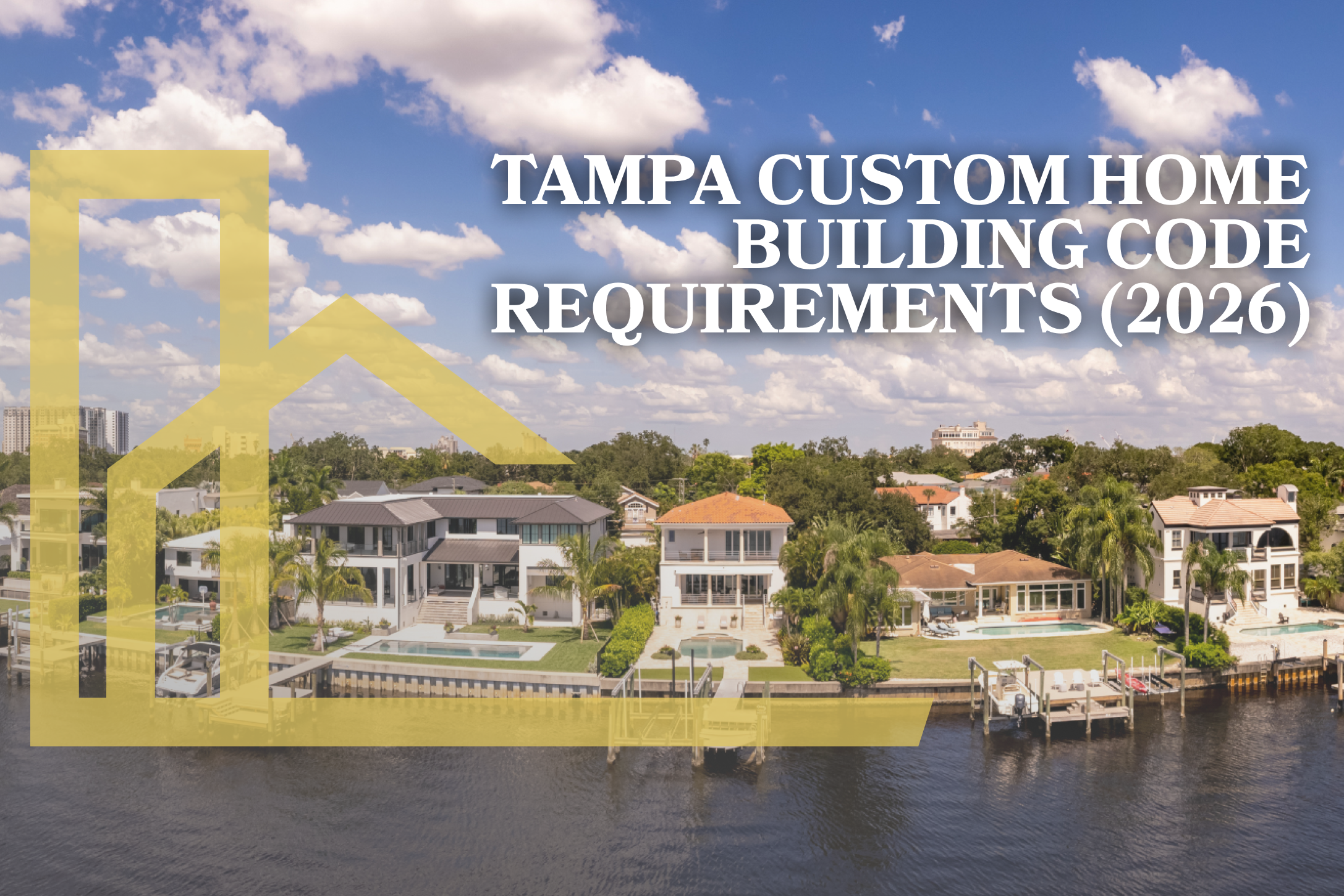
Building a custom home in Tampa is one of the most exciting things a family can do. It's also one of the most regulated — Florida's building codes are among the strictest in the country, and understanding them before you start saves you from expensive surprises mid-project.
Here's what the Florida Building Code actually requires for new custom homes in Tampa in 2026.

After Hurricane Andrew leveled South Florida in 1992, the state rebuilt its construction standards from the ground up. The current 8th Edition Building Code — effective since late 2023 — governs every permit issued in Tampa and Hillsborough County. Everything in it flows from one reality: Florida builds in hurricane territory.
Tampa and Hillsborough County fall within the Wind-Borne Debris Region. Every new home must be designed to withstand 150–160 mph ultimate design wind speeds under ASCE 7-22. In practice:
When your architect and contractor specify these elements, they're not padding the budget — they're building to code.
The Wind-Borne Debris Region designation means every opening needs one of two things:
For most custom homes, impact windows and doors are the practical choice — no one wants to deploy shutters before every storm. The cost premium runs $200–$600 per opening, but insurance savings through wind mitigation credits offset that over time. Guardian Home's county-by-county breakdown is a useful reference if your project straddles county lines.

The 8th Edition's energy standards apply to every new home in Tampa:
These standards add upfront cost and meaningfully cut operating expenses in a climate where AC runs 9–10 months a year.
Tampa has significant flood exposure. Look up your lot before drawing a single line. Hillsborough County's flood zone lookup and the City of Tampa's flood information page are your starting points.
Zone X: Minimal risk. Standard construction applies.
Zone AE: High-risk. Your lowest floor must sit at or above Base Flood Elevation plus one foot of freeboard. An elevation certificate is required at permit application and again before Certificate of Occupancy.
Zone VE: Coastal high-hazard. Pile or column foundations only — no fill or slab-on-grade. All mechanical systems must be elevated above freeboard. A second elevation certificate is required.
In AE or VE zones, flood elevation requirements will significantly affect your foundation design and total project cost. Plan for it from day one.

Every custom home requires a building permit from the City of Tampa Construction Services division. Under HB 267, Tampa must complete its initial review within 30 business days — and refund fees if it misses that deadline.
Your contractor submits the full package: sealed architectural and structural drawings, energy compliance documentation, flood zone documentation, site plans, and MEP plans. Your job is to choose your builder and finalize your design. The permitting process is theirs to manage.
Tampa inspects at every major milestone — foundation, framing, rough-in trades, insulation, and final. Each phase must pass before the next begins. A contractor who schedules inspections proactively and communicates results keeps your project on track. One who doesn't can cost you weeks.
Have you built in the City of Tampa recently? Local relationships with plan reviewers and inspectors matter more than most people realize.
Are you state-certified? New residential construction requires a CGC or CBC license. Verify at myfloridalicense.com before signing anything.
Who manages inspections? The answer should be: we do, and we tell you every result.
What's your flood zone experience? In Tampa, this is a baseline question, not a specialty one.
You can't pull "code compliance cost" out of a well-built home's budget — it's woven into every material and every labor hour. What you can do is avoid contractors who cut corners on it, because those corners show up at resale, in insurance claims, and in the next major storm.
Bettencourt Construction has been building to Florida's codes since the late 1980s. The requirements exist because homes built to them survive. That's 30 years of observed reality on the Gulf Coast.
Talk to our team about your Tampa custom home
Related reading:
What hurricane-resistant features are required in Sarasota?
Flood zone rules for St. Pete home additions
How to verify a contractor's license in Florida

.webp)


